
Sitemap
A list of all the posts and pages found on the site. For you robots out there is an XML version available for digesting as well.
Pages
Posts
Future Blog Post
Published:
This post will show up by default. To disable scheduling of future posts, edit config.yml and set future: false.
Blog Post number 4
Published:
This is a sample blog post. Lorem ipsum I can’t remember the rest of lorem ipsum and don’t have an internet connection right now. Testing testing testing this blog post. Blog posts are cool.
Blog Post number 3
Published:
This is a sample blog post. Lorem ipsum I can’t remember the rest of lorem ipsum and don’t have an internet connection right now. Testing testing testing this blog post. Blog posts are cool.
Blog Post number 2
Published:
This is a sample blog post. Lorem ipsum I can’t remember the rest of lorem ipsum and don’t have an internet connection right now. Testing testing testing this blog post. Blog posts are cool.
Blog Post number 1
Published:
This is a sample blog post. Lorem ipsum I can’t remember the rest of lorem ipsum and don’t have an internet connection right now. Testing testing testing this blog post. Blog posts are cool.
books
Atomic Habits
By James Clear | Rating: 4.5/5
A practical framework for building better systems and making tiny improvements stick.
portfolio
IITB Mars Rover Team
The IITB Mars Rover Team was founded in 2012 with the goal of understanding the science and engineering behind building a rover for the red planet. The team has grown to be a platform for experimentation and production of rover prototypes, similar to how NASA has produced rovers such as the Pathfinder. The team has its own line of 6 rovers that have been upgraded to become more advanced and robust over time.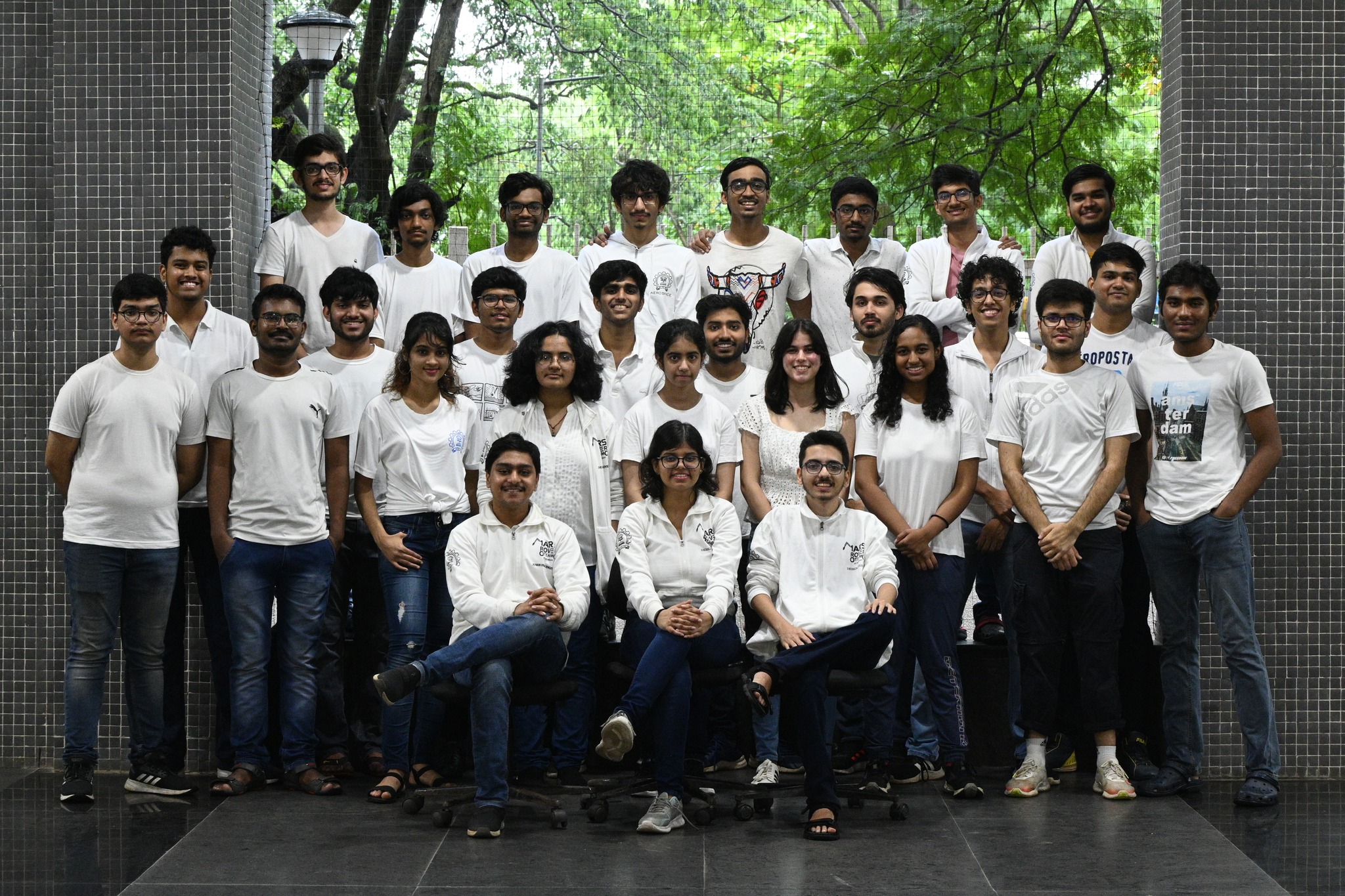
Portfolio item number 2
Short description of portfolio item number 2 
publications
LiveStreaming AI: Merchandisable Moment Identification and Offer Generation
US Patent App. 18/176,114
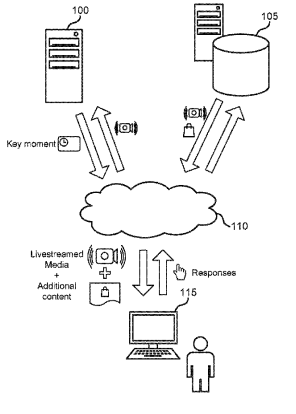
A patent application on identifying merchandisable moments in livestreams and generating offers.
Robust Depth-Aided Segmentation for Drivable Region Detection in Challenging Environments
ICRA 2024 Workshop on Resilient Off-road Autonomy
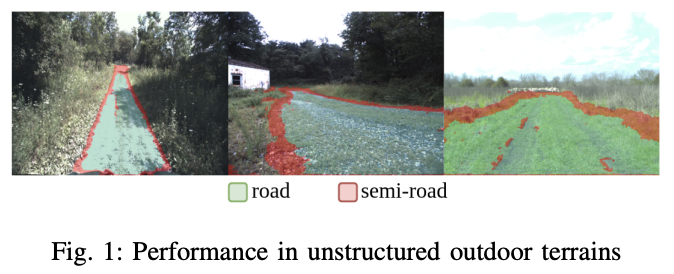
This paper proposes a method for detecting drivable regions in challenging terrains using RGB-D data. By integrating depth information with semantic segmentation, our approach significantly improves detection accuracy across diverse landscapes. Leveraging the SegFormer architecture, we effectively distinguish drivable from non-drivable areas. Additionally, we introduce a depth-based refinement mechanism to ensure reliable performance in real-world scenarios. Extensive evaluation in both off-road and on-road environments confirms the effectiveness of our approach. Using the SA-1B dataset with grounded SAM, our method achieves precise delineation of road classes during training. Overall, this work advances autonomous navigation systems by providing a comprehensive solution for drivable region detection in complex terrains in real time, even on edge computing devices.
CogAI@ SMM4H 2024: Leveraging BERT-based Ensemble Models for Classifying Tweets on Developmental Disorders
Proceedings of The 9th Social Media Mining for Health Research and Applications (SMM4H 2024) Workshop and Shared Tasks
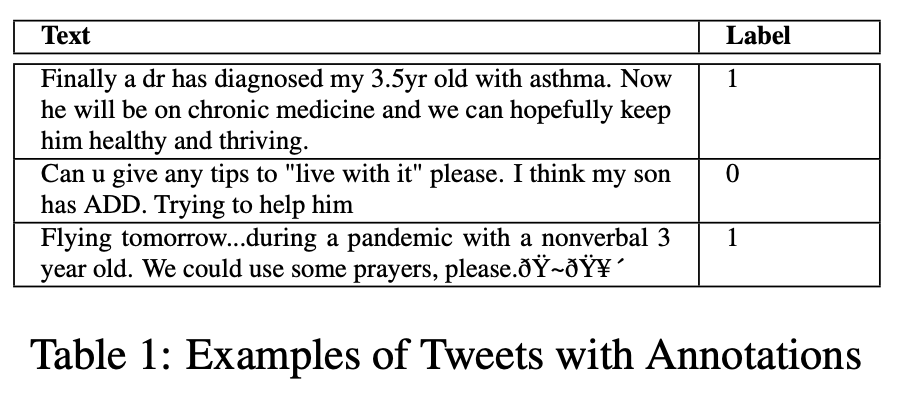
This paper presents our work for the Task 5 of the Social Media Mining for Health Applications 2024 Shared Task-Binary classification of English tweets reporting children’s medical disorders. In this paper, we present and compare multiple approaches for automatically classifying tweets from parents based on whether they mention having a child with attention-deficit/hyperactivity disorder (ADHD), autism spectrum disorders (ASD), delayed speech, or asthma. We use ensemble of various BERT-based models trained on provided dataset that yields an F1 score of 0.901 on the test data.
A Cognitive Analysis of CEO Speeches and Their Effects on Stock Markets
Proceedings of 5th International Conference on Financial Technology
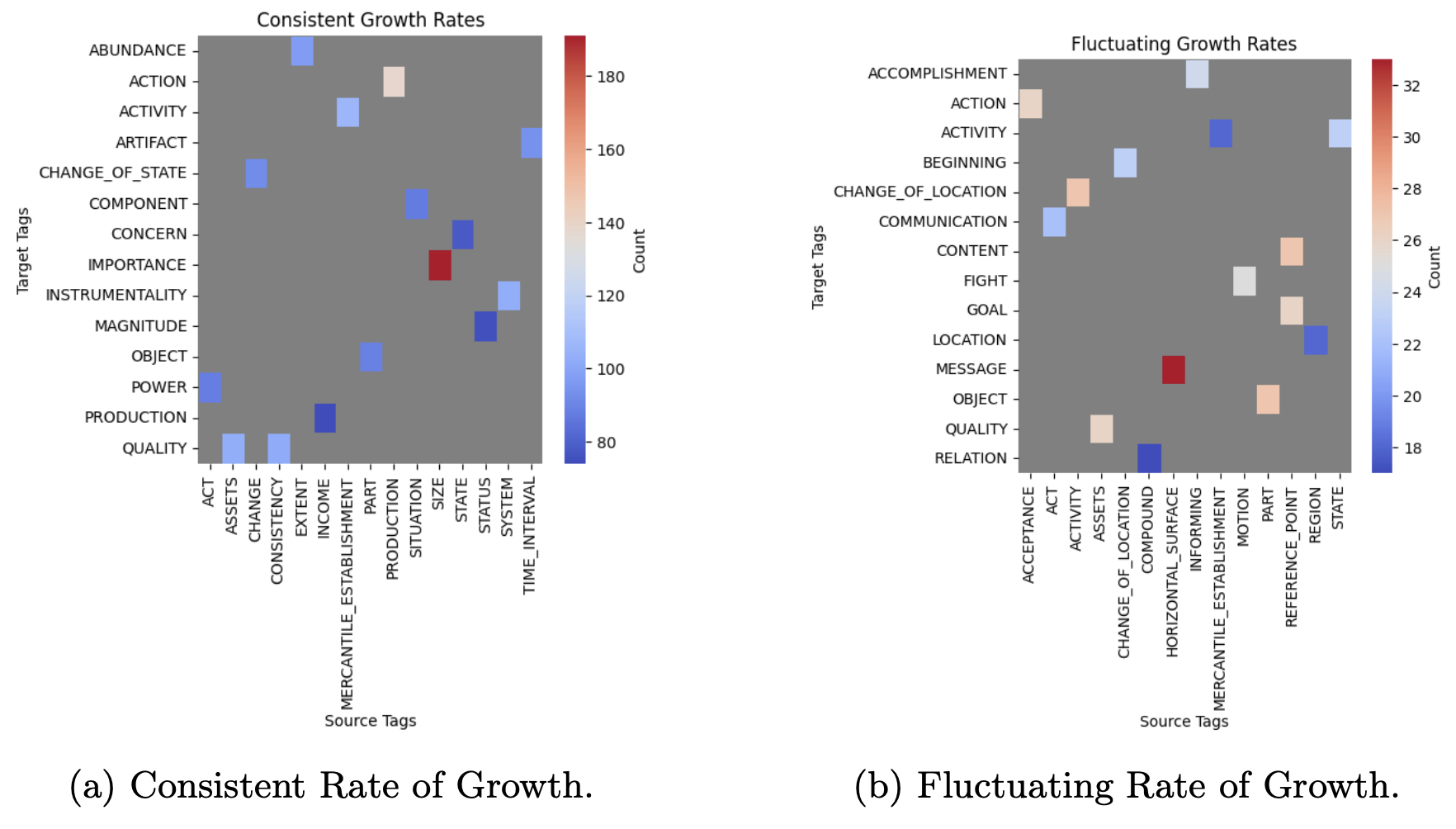
The cognitive state of a CEO can have a great impact on the company’s operational results and stock market performance. Conventional cognitive analysis often relies on interviews with cognitive scientists or psychologists, which are not readily scalable for big data applications in finance. In this work, we leverage a novel method to analyze the cognitive states of top-tier managers of 14 well-known companies. We analyze the concept mappings from their speeches and metaphorical expressions over 15 years. We also conduct breakdown analysis for the concept mappings, according to the trends of stock prices. We identify four distinct types of stock market performance and illustrate the featured concept mappings associated with each category. These representative concept mappings reflect the cognitive states of CEOs and provide insights into which cognitive states are most likely to correlate with positive stock market performance.
Visual Loop Closure Detection Through Deep Graph Consensus
IEEE/RSJ International Conference on Intelligent Robots and Systems (IROS 2025)
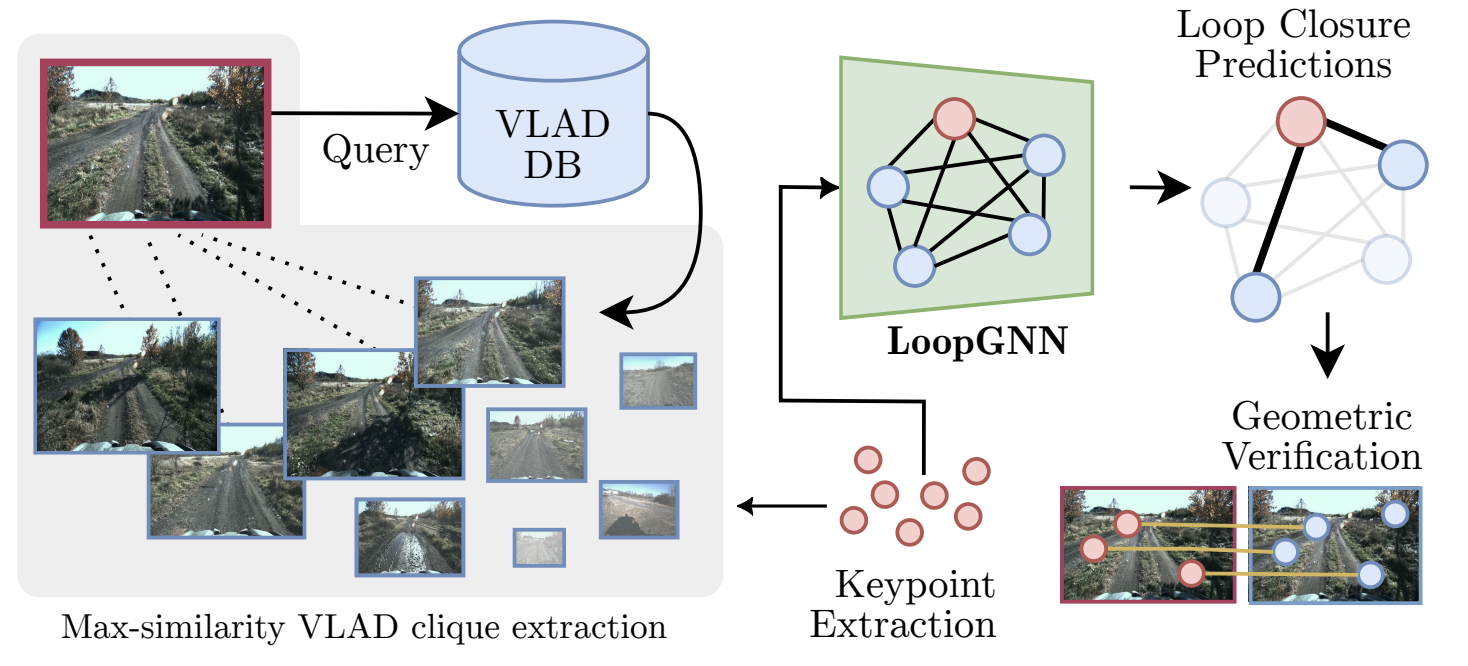
Visual loop closure detection traditionally relies on place recognition methods to retrieve candidate loops that are validated using computationally expensive RANSAC-based geometric verification. As false positive loop closures significantly degrade downstream pose graph estimates, verifying a large number of candidates in online simultaneous localization and mapping scenarios is constrained by limited time and compute resources. While most deep loop closure detection approaches only operate on pairs of keyframes, we relax this constraint by considering neighborhoods of multiple keyframes when detecting loops. In this work, we introduce LoopGNN, a graph neural network architecture that estimates loop closure consensus by leveraging cliques of visually similar keyframes retrieved through place recognition. By propagating deep feature encodings among nodes of the clique, our method yields high-precision estimates while maintaining high recall. Extensive experimental evaluations on the TartanDrive 2.0 and NCLT datasets demonstrate that LoopGNN outperforms traditional baselines.
FPSBench: A Benchmark for Video Understanding at High Frame Rates
CVPR 2026
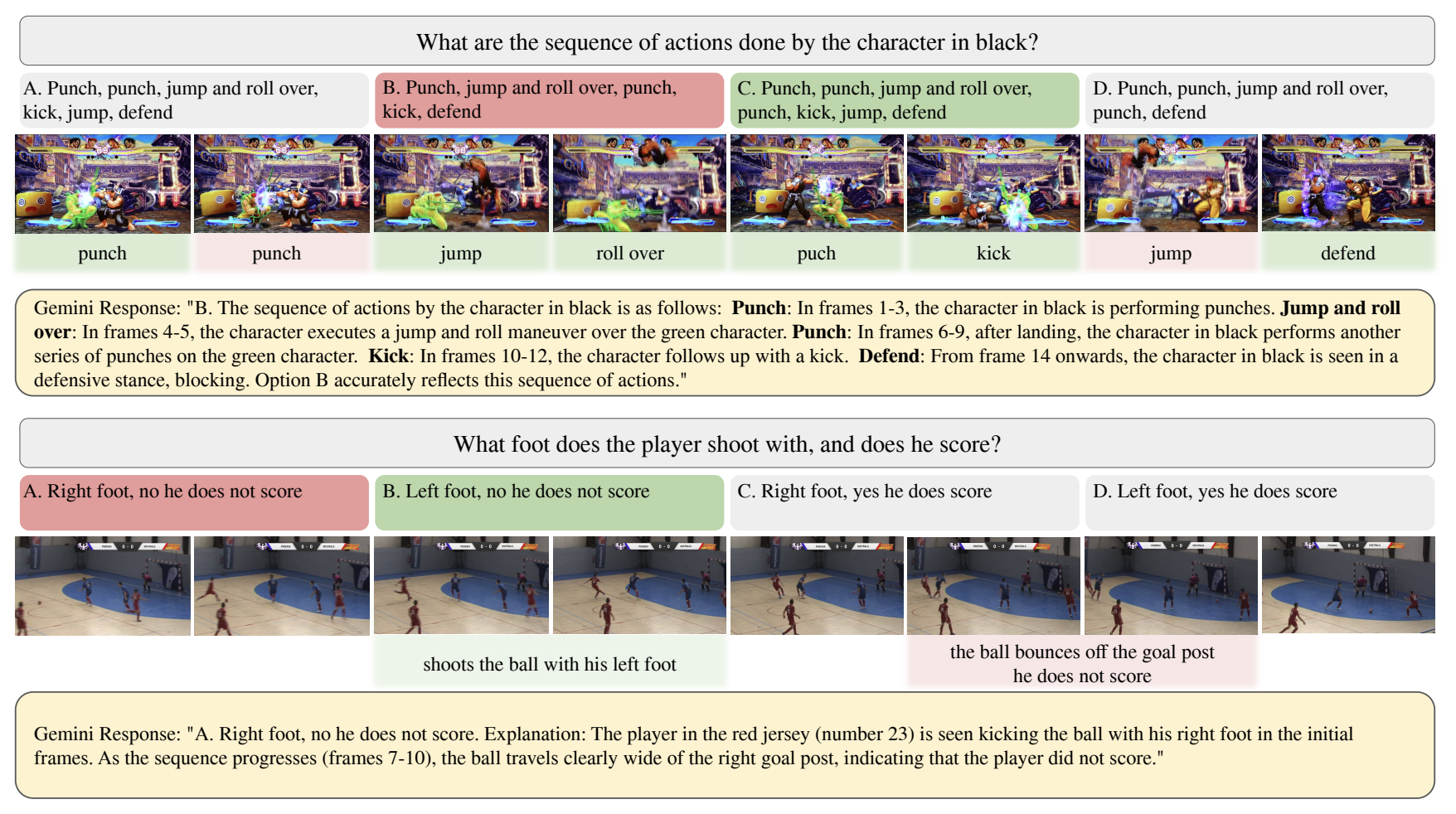
Modern video-language models are typically trained on videos downsampled to low frames-per-second (FPS), and the most commonly used evaluation benchmarks are designed for low-FPS input as well. To address this shortcoming, we present FPS-Bench, a large video question-answering benchmark designed to evaluate VLMs’ capabilities to understand video at high-frame rates. We introduce a new metric, the minimum frames-per-second (minFPS), which measures the minimum frame-rate required to solve a given question. While existing benchmarks require <1 minFPS, we rigorously curate more than 1000 questions from a diverse source of videos and manually verify minFPS for each example, leading to a benchmark that requires watching videos at on average 7 FPS to solve. Our evaluation of several state-of-the-art VLMs shows that they are severely lacking, achieving QA accuracy of 30% in the FPS-Bench multiple-choice task, while humans achieve 72% accuracy.
Digital Epidemiology: Social Media Analysis for Insights into Epilepsy and Mental Health
Journal of Computational Social Science 9 (1), 1
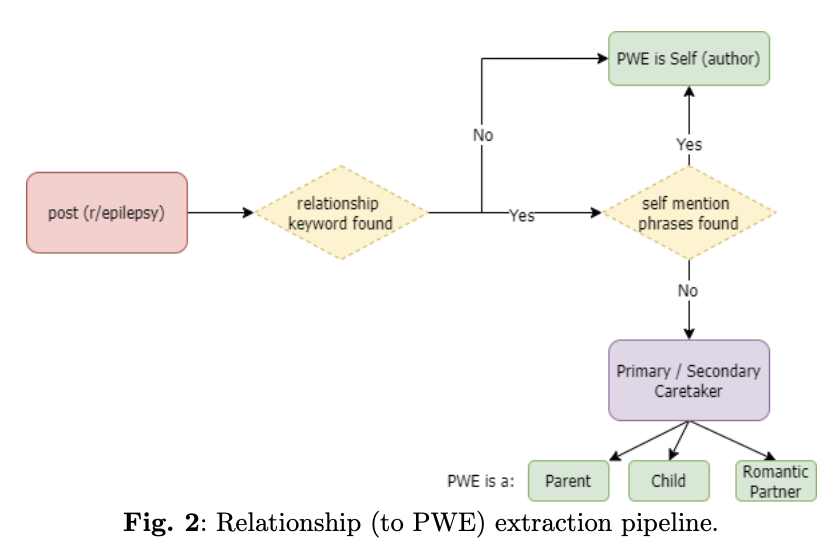
Social media platforms, particularly Reddits r/Epilepsy community, offer a unique perspective into the experiences of individuals with epilepsy (PWE) and their caregivers. This study analyzes 57k posts and 533k comments to explore key themes across demographics such as age, gender, and relationships. Our findings highlight significant discussions on epilepsy-related challenges, including depression (with 39.75% of posts indicating severe symptoms), driving restrictions, workplace concerns, and pregnancy-related issues in women with epilepsy. We introduce a novel engagement metric, F(P), which incorporates post length, sentiment scores, and readability to quantify community interaction. This analysis underscores the importance of integrated care addressing both neurological and mental health challenges faced by PWE. The insights from this study inform strategies for targeted support and awareness interventions.
talks
RoboticsXTokyo: Venture Café Global Gathering Permalink
Published:
Spoke at the Global Gathering event hosted by Venture Café Tokyo and RoboticsXTokyo on the robotics landscape in Japan and India, and how the two countries can collaborate for innovation and growth. Introduced the concept of “Jugaad” — a uniquely Indian approach to frugal innovation.
teaching
 CS 152: Introduction to Computer Science
Undergraduate, Indian Institute of Technology, Bombay, 2021
 16-385: Computer Vision (Spring 2026) Permalink
Graduate, Carnegie Mellon University, 2026